
Most payrolls look fine.
That’s usually the problem.
Because when payroll is wrong, it rarely looks wrong.
The figures seem reasonable.
The totals add up.
But behind the scenes, things aren’t always being calculated correctly.
Why we’re sharing this
We don’t usually write blogs like this.
But over the last few months, as we’ve onboarded new clients, we’ve started to see the same issues appear again and again.
Small things.
The kind of things that are easy to miss if you don’t work in payroll every day.
But in payroll, small issues don’t stay small.
And with year end approaching, we felt it's worth sharing even if it helps one business spot something before it becomes expensive to fix.
A real example (anonymised)
A new Financial Controller joined a business.
As part of getting up to speed, they reviewed the payroll. Nothing looked obviously wrong, but the numbers didn’t quite stack up.
So they asked us to take over their payroll and review the historic payroll.
What we found
This wasn’t one major issue.
It was a series of smaller ones:
- Employees hadn’t been correctly assessed for auto-enrolment
- Benefits in kind had the wrong National Insurance treatment
- Expenses were treated as non-taxable, despite being paid as allowances above HMRC limits
Individually, none of these stood out on a payslip.
But together, they told a different story.
- The payroll didn’t look wrong.
- But it wasn’t right either.
How it added up
Because these issues sat within the setup, they weren’t visible to the client unless they checked thoroughly.
The payroll reports looked reasonable, but behind the scenes, the system was applying the wrong rules.
Over time, this led to:
- Underpaid pension contributions
- Incorrect tax and National Insurance calculations
- Adjustments required across multiple tax years
In this case, correcting the payroll meant going back over 3 tax years. The full review and correction process took just over 5 weeks. For the first week, we worked on-site with the client, identifying issues, asking questions and building a clear picture of what the payroll should have looked like.
Only once we had that clarity could we start putting things right.
In this case, with just over 260 employees, the total cost ran into the thousands in under/over tax payments, underpaid pension contributions. Not because of one big mistake, but because no one had checked how the payroll was set up.
Why this happens more than people think
Most businesses check their payroll.
They look at:
- Gross pay
- Bonus / Commision
- Overtime
- Allowances
- SMP, SSP
- Pensions as a whole
- Totals
And if those figures look right, payroll gets approved. But payroll doesn’t just rely on the numbers you see. Most businesses check their payroll. They just don’t check the part that matters.
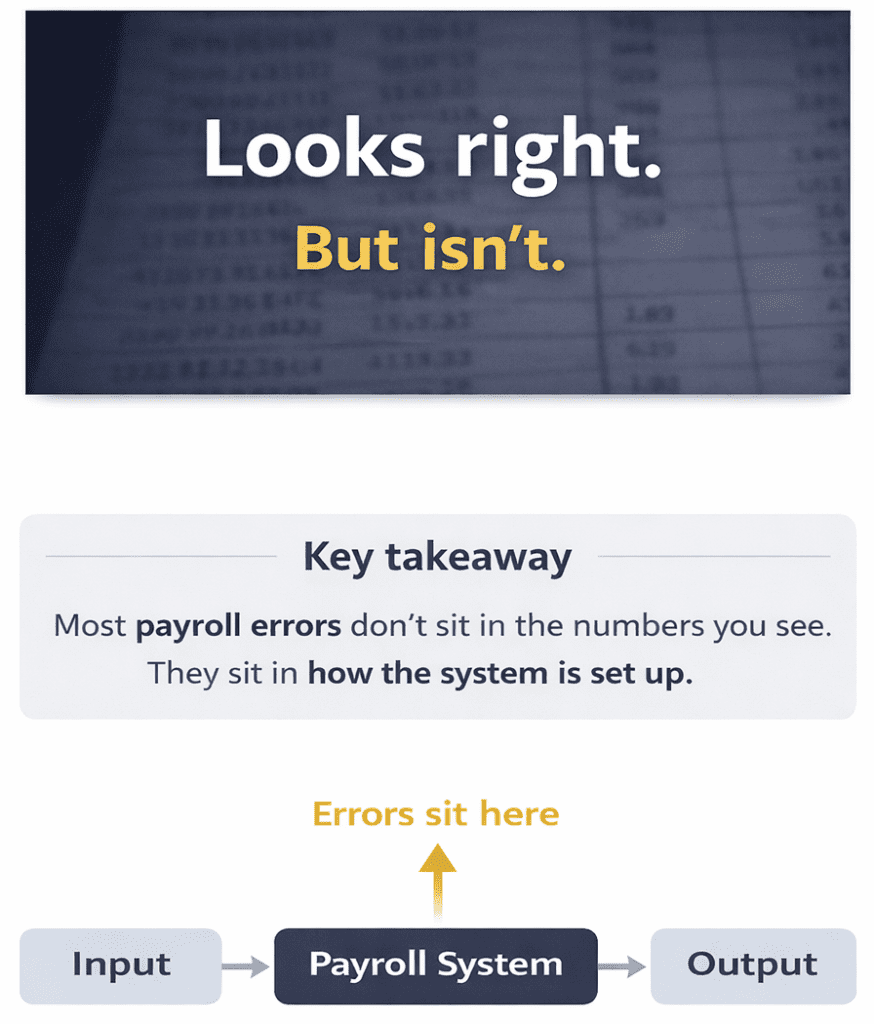
Behind the scenes, the system is applying rules:
- Tax codes
- National Insurance thresholds
- Pension assessments
- Statutory calculations
This is where payroll errors in tend to sit. Not in the output, but in the setup.
The real risk
The issue with payroll errors isn’t that they happen.
It’s how long they sit there. Month after month, sometimes, year after year as in this case, until something triggers a review:
- A query from HMRC
- An employee question
- A pension reconciliation
- A new finance person asking questions
And by that point, you’re not fixing one payroll, you’re going back through history.
Can it be fixed?
In every case, yes.
But it often means:
- Re-running payroll calculations
- Correcting pension submissions
- Reviewing multiple tax periods
What could have been a small fix early on becomes a much bigger job later.
A simple question worth asking
If you run payroll internally or through a provider, it’s you should be asking:
Who actually checks the payroll and how?
Not just the figures going in.
But:
- How the system is set up
- Whether employees are assessed correctly
- Whether the rules are being applied properly
Because that’s where issues tend to sit.
Final thought
This is based on a real scenario (anonymised).
And the common thread is simple:
The payroll didn’t look wrong, but it wasn’t right either.
If you’re not 100% confident how your payroll is set up, it’s it's always worth checking before it becomes expensive to fix. Alternatively, you can do some checks yourself, using HMRC calculators:
- Work out an employee's National Insurance contributions - GOV.UK
- Work out an employee's Income Tax - GOV.UK
Make sure you print out your results.
Want a second pair of eyes?
If you're not sure how your payroll is setup, we’re always happy to have a short, no-pressure conversation.
If you found this article useful, you may find the accompanying article useful: Who Actually Checks Your Payroll?