

Most companies believe they check payroll.
Before payroll is submitted, someone usually reviews the numbers:
- Do salaries reconcile?
- Do the overtime totals look right?
- Does the total gross pay match expectations?
- Have sickness or statutory payments been entered?
- Do the pension deductions look correct?
- Have P45s been issued
The figures look reasonable, so payroll must be correct, right?
No! and here’s the problem.
Most companies check the numbers they send into payroll.
Very few check how the payroll system actually calculates them and here is the problem:
The Payroll Iceberg
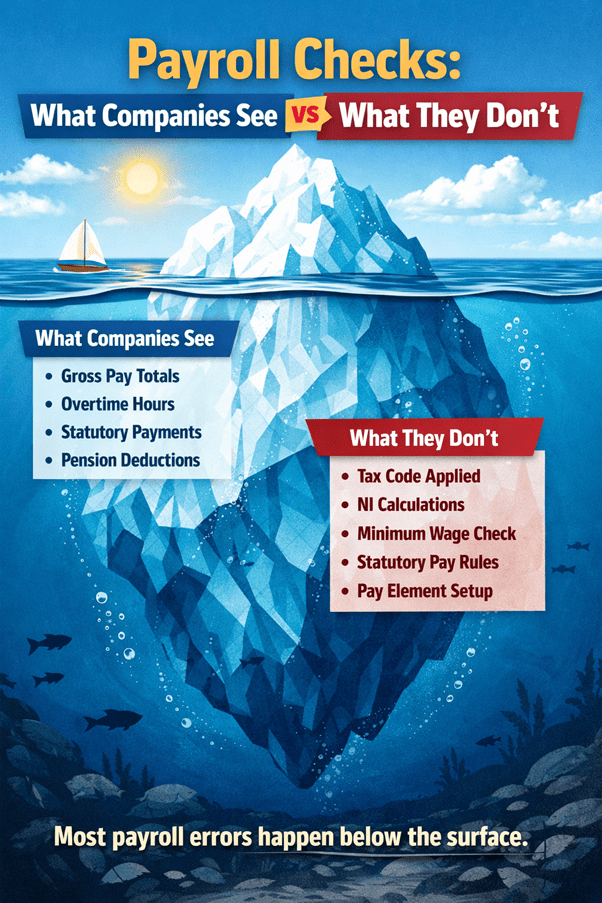
Payroll works a lot like an iceberg. The part you see is only a small part of the process.
Above the surface are the checks most organisations perform.
What companies usually check
- Gross pay totals
- Overtime amounts
- Statutory payments entered
- Attachment of earnings deductions
- Pension deductions
These checks confirm the data going into payroll.
But the largest part of payroll sits below the surface.
What many companies never check
- Tax code application
- National Insurance calculations
- Pension eligibility assessments
- National Minimum Wage compliance
- Statutory pay calculations
- Payroll element configuration
These calculations happen inside the payroll system, and this is where many payroll errors begin.
When Payroll Looks Right — But Isn’t
Payroll errors can continue for months or years because payroll can look correct.
- The totals balance.
- The payslips look correct.
- Employee’s don’t complain.
But the calculations inside the system may still be wrong.
Here is a simple example.
| What Finance Checks | What Could Actually Be Wrong |
| Gross pay matches hours worked | Incorrect tax code applied |
| Pension deduction appears correct | Employee should not yet be enrolled |
| Statutory pay entered | Average weekly earnings calculated incorrectly |
| Net pay looks reasonable | Minimum wage breach due to salary sacrifice |
From the outside, the payroll looks fine. Inside the system, the rules may be wrong.
Unless someone checks those rules, the error can continue payroll after payroll, until one day a letter lands in your reception letting you know HMRC are conducting a compliance check, or worse, you’re taken to an employment tribunal and you realise you’ve been deducting too much tax, or not enough, or the employees pension is wrong.
So what do you do about it?
How to Check Payroll Properly
If payroll sits under finance in your organisation, it can help to have a process to review how payroll is actually checked.
Here are a few simple questions to ask.
1. Who confirms payroll calculations have been reviewed?
Before the payroll submission is sent to HMRC, someone should confirm the calculations have been checked.
If nobody signs this off, payroll may simply be assumed to be correct.
2. Are tax calculations ever checked?
Payroll software calculates PAYE automatically.
However, incorrect tax codes or employee setup can cause errors.
HMRC provides calculators for checking income tax calculations and it’s a good idea to check a few employees each payroll using the HMRC Calculator.
https://www.gov.uk/guidance/work-out-an-employees-income-tax
3. Are National Insurance calculations verified?
NI calculations depend on correct thresholds and employee categories.
You can review HMRC guidance here and again, check a few employees randomly each payroll:
https://www.gov.uk/guidance/work-out-an-employees-national-insurance-contributions
4. Are statutory payments being calculated correctly?
Statutory payments rely on rules such as qualifying periods and average weekly earnings.
HMRC calculators can help verify these calculations.
Statutory Sick Pay
https://www.gov.uk/calculate-statutory-sick-pay
Maternity and Paternity Pay
https://www.gov.uk/maternity-paternity-calculator
A Simple Payroll Review Checklist
To help finance teams start reviewing payroll processes, we’ve created a simple Payroll Review Checklist you can build on to suit your business.
The spreadsheet walks through common areas where payroll issues can occur, including:
- payroll system setup
- employee configuration
- payment types
- statutory pay setup
- pension configuration
- payroll processing checks
You can download the checklist here:
Download the Payroll Review Checklist
The spreadsheet is designed so finance teams can quickly work through key payroll checks and identify areas that may need further review. Please add columns or rows to suit your own circumstances and organisation
Payroll Shouldn’t Just Be Processed
Payroll software is powerful.
But like any system, it only produces the correct result if the setup and rules behind it are correct.
Reliable payroll processes usually include two types of checks:
- Checking the data going into payroll
- Checking how the payroll system calculated it
Most companies already do the first. Very few do the second.
One Question Worth Asking
Whether payroll is processed internally or outsourced, it is worth asking one simple question:
How do we know the payroll calculations themselves have been checked?
For many organisations, that question is where hidden payroll risks start to appear.
If you found this article useful, you may also find the following payroll articles helpful:
- Who Actually Checks Your Payroll?
- New Parental Rights April 2026: What Employers Need to Know (Without the Jargon)
- The 7 Monthly Payroll Checks Good Providers Run (That Most Employers Never See)
- HR and Payroll Data Check's Every Employer Should Do (Before Small Errors Become Big Problems)
- Can You Change Payroll Mid-Tax Year? Yes – Here’s How
If you would like help reviewing your payroll setup
If you’re unsure whether your payroll calculations are being checked properly, it may be worth having your payroll process reviewed.
At Crystal HR & Payroll we regularly review payroll setups for businesses to help identify configuration issues, compliance risks, or areas where processes could be improved.
If you’d like a second pair of eyes on your payroll setup, you’re welcome to book a short no obligation call with our team.